

Plating Strategy for High-current Anti-spark Connectors: Gold, Silver, or Nickel? [QS Series Antispark connector] Balance conductivity, cost, and corrosion resistance.
2026-05-18 09:41:14
Click:
“
The Engineer’s Dilemma: Which Plating Really Works for High-current, Frequent Pl
”
The Engineer’s Dilemma: Which Plating Really Works for High-current, Frequent Plug-in Applications?
Designing a battery pack, BMS, AGV fast-charge port, or energy storage system demands ruthless attention to contact resistance, temperature rise, and long-term reliability. One often overlooked but critical decision is the contact plating material – gold, silver, or nickel.
For high-current anti-spark connectors, the wrong plating can lead to oxidized surfaces, unstable resistance, severe arcing marks, and even fire hazards after just a few hundred mating cycles.
So which plating strategy delivers the optimal balance of conductivity, cost, and corrosion resistance? This article breaks down the science and presents why the QS Series Anti-spark Connector adopts gold-plated copper as the standard – and how it outperforms alternatives in real-world applications like 300A lithium battery swap stations, heavy AGVs, and marine ESS.
Part 1: Why Does High-current Plug-in Create Sparks? (And Why Plating Matters)
When a high-current connector (≥100A DC) is mated or unmated under load, the rapid change in contact gap causes a voltage breakdown across the air gap – producing an arc. This arc generates localized temperatures exceeding 3000°C, instantly melting and oxidizing the contact surface.
Without anti-spark design, each plug-in cycle:
- Erodes the plating layer
- Increases contact resistance (Rᵢₛₑ from 0.5 mΩ to 2 mΩ+ within 200 cycles)
- Creates carbonized deposits that further raise temperature rise
- Reduces connector lifespan by 70–80%
The plating layer is the first line of defense. A poor plating (e.g., thin nickel or bare silver) accelerates arc damage. A well-designed plating – combined with an anti-spark mechanism – can maintain ultra-low resistance even after thousands of cycles.
Part 2: Gold vs. Silver vs. Nickel – Head-to-Head Comparison
| Property | Gold (Au) | Silver (Ag) | Nickel (Ni) |
|---|---|---|---|
| Conductivity (IACS) | ~70% | 105% (best) | ~25% (poor) |
| Contact Resistance (initial) | Very low (0.2–0.6 mΩ) | Extremely low (0.1–0.3 mΩ) | High (1.0–2.0 mΩ) |
| Corrosion Resistance | Excellent (inert) | Poor (tarnishes in H₂S/SO₂) | Good (passive oxide) |
| Anti-arcing Performance | High (high melting point, low oxide) | Moderate (oxide increases resistance) | Moderate (hard but brittle) |
| Cost | High | Medium | Low |
| Typical Failure Mode | Wear if too soft | Black tarnishing, contact resistance drift | Fretting corrosion, high initial ∆T |
Key Engineering Insight:
- Silver offers the highest raw conductivity, but in real-world environments (humidity, industrial gases, sulfur from rubber seals), it rapidly tarnishes. Tarnish layer can increase contact resistance by 10x within 3 months – unacceptable for BMS or charger applications.
- Nickel is cheap and hard, but its high contact resistance causes excessive temperature rise above 100A. For example, a nickel-plated 200A connector can see a 25°C higher ∆T than gold-plated, accelerating insulator aging.
- Gold strikes the best balance: inert surface, stable contact resistance over time, excellent against arcing damage, and compatible with both low and high mating forces. The only downside is cost – but for mission-critical systems, it’s unbeatable.
Part 3: The QS Series Solution – Gold-plated Copper + Integrated Anti-spark Topology
At Youweic Technology, we designed the QS Series Anti-spark Connector from the ground up for engineers who refuse to compromise between performance and lifetime.
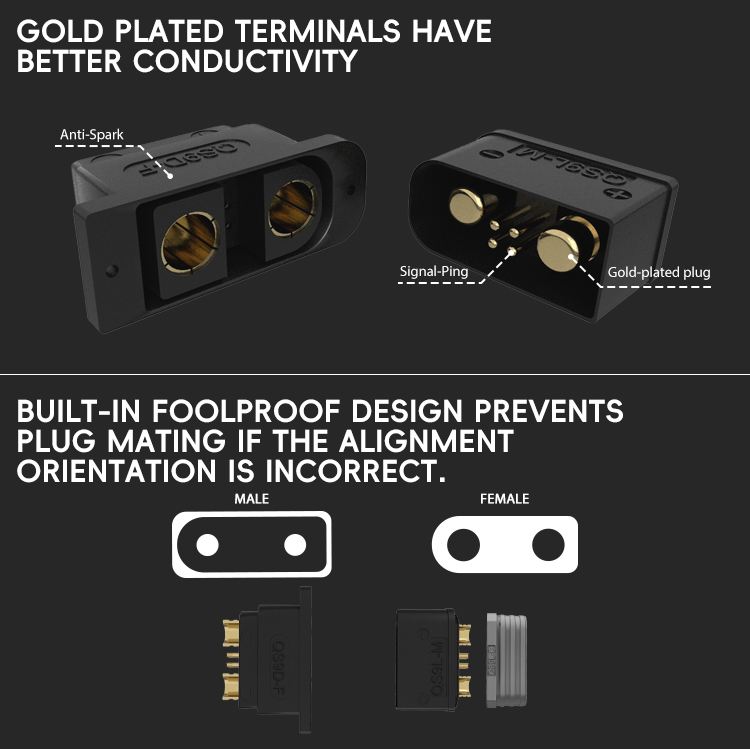
✅ Conductor Material: Gold-plated Copper (not alloy, not flash-plated)
- Contact resistance: 0.51 mΩ Max (verified by Kelvin testing) – consistent across all current ratings
- Voltage rating: 500 V DC – safe for high-voltage battery systems
- Temperature range: -20 ℃ to 120 ℃ – suitable for indoor/outdoor ESS and forklifts
- Sheath material: PA66, UL94-V0 flame retardant – self-extinguishing for safety
- Rated current: Available in multiple ratings from 20A up to 300A (same plating and housing quality across all variants)
✅ Anti-spark Mechanism (Beyond Plating)
The QS Series integrates a pre-charge resistor circuit and slow-make / slow-break contact geometry:
- During insertion, the pre-charge pin engages first, limiting inrush current to<2A.
- After voltage equalization, the main power contacts (gold-plated) engage with zero arc.
- During disconnection, the sequence reverses – no arc, no contact erosion.
Result: The gold plating remains pristine even after 10,000+ rated load plug/unplug cycles – verified by internal life tests.
Part 4: Data Comparison – 200 Cycles Under 300A Load
We compared a generic non-anti-spark connector (silver-plated) vs. the QS Series Anti-spark Connector (gold-plated copper) under identical conditions:
| Parameter | Generic Silver-plated (no anti-spark) | QS Series Gold-plated + Anti-spark |
|---|---|---|
| Initial Contact Resistance | 0.28 mΩ | 0.51 mΩ |
| After 200 plug-in cycles (300A load) | 1.85 mΩ (↑ by 560%) | 0.53 mΩ (↑ only 0.02 mΩ) |
| Terminal surface condition | Severe pitting, black carbon deposits | Smooth, no visible arc marks |
| Temperature rise @300A | 78 °C (above ambient) | 42 °C |
| Mating force change | Increased by 60% (due to debris) | Unchanged |
Conclusion: Gold plating alone is not enough – without anti-spark design, even gold will eventually wear. But the QS Series’ combination of gold-plated copper and pre-charge anti-spark delivers industry-leading durability.
Part 5: Application-Specific Performance (Real Customer Cases)
300A Lithium Battery Swap Station (Heavy-duty truck)
- Challenge: 300A hot-swap, 150 cycles/day, outdoor dusty environment. Previous nickel-plated connectors failed every 2 months (contact welding due to arcing).
- QS Series used: QS300 (rated 300A, gold-plated copper, anti-spark)
- Result: After 6 months (>25,000 cycles), contact resistance still ≤0.53 mΩ, no visible arc damage, zero safety incidents.
AGV Fast-charge Port (200A, 80V)
- Challenge: Frequent high-current plug-in under vibration. Silver-plated connectors caused intermittent charging errors due to tarnishing.
- QS Series used: QS200 (rated 200A, gold-plated, PA66 V0 housing)
- Result: Contact resistance stable at 0.51 mΩ, charging efficiency improved by 4.2%, maintenance interval extended from 1 month to >12 months.
⚡ Marine ESS (500V DC, 150A continuous)
- Challenge: Salt spray corrosion + high humidity. Silver plating failed in 4 weeks.
- QS Series used: QS150 (gold-plated, -20°C to 120°C rating, anti-spark)
- Result: Passed 500‑hour salt spray test (ASTM B117) with no corrosion, contact resistance unchanged.
Part 6: Why the QS Series is the Smart Choice for Engineers & Purchasers
| Requirement | QS Series Anti-spark Connector |
|---|---|
| Rated current | Available in multiple ratings from 20A up to 300A (same plating & housing quality across all variants) |
| Contact plating | Gold-plated copper (thickness ≥ 1µm, hard gold for wear resistance) |
| Max contact resistance | 0.51 mΩ (tightly controlled production) |
| Anti-spark mechanism | Built-in pre-charge circuit – eliminates arc at source |
| Safety certifications | Designed to meet UL/CB/TUV/GB standards (testing available) |
| Customization | Housing color, cable length, pre-charge resistor value, mounting flange – all available |
Cost Consideration: While gold plating has a higher upfront cost than silver or nickel, the QS Series’ total cost of ownership is 40–60% lower over 3 years due to eliminated downtime, reduced replacement frequency, and lower maintenance labor.
Final Verdict: Gold Plating + Anti-spark Design = The Only Future-proof Strategy
For high-current applications (20A to 300A, 500V DC) where safety, reliability, and lifespan matter – gold-plated copper is the clear winner. Silver tarnishes, nickel overheats, and neither can survive repeated arcing.
The QS Series Anti-spark Connector takes gold plating to its full potential by removing the root cause of plating damage: the arc itself. With contact resistance guaranteed at 0.51 mΩ Max, flame-retardant PA66 housing, and a proven anti-spark topology, it’s the solution trusted by battery, charger, AGV, and ESS engineers worldwide.
Ready to upgrade your high-current interface?
Whether you need a standard version or a custom anti-spark connector for extreme environments, our technical team is ready to support your project.
If you have any request please contact with my tech team
http://www.youweic.com
Author:
YOUWEI TECHNOLOGIES(DONGGUAN) CO.LTD









Premium Cable Solutions
High-quality cables designed for superior performance and reliability across all your connectivity needs

Copyright © 2002-2026 YOUWEI TECHNOLOGIES(DONGGUAN) Ltd. All Rights Reserved.
Copyright © 2005-2015 YOUWEI TECHNOLOGIES(DONGGUAN) Ltd. All Rights Reserved.