

In-Depth Analysis Report on Future Global Drone Market Demand
2026-05-17 13:13:59
Click:
“
In-Depth Analysis Report on Future Global Drone Market DemandCore Conclusion: Ov
”
In-Depth Analysis Report on Future Global Drone Market Demand
Core Conclusion: Over the next 5-10 years, the global and Chinese drone market demand will maintain a sustained high compound annual growth rate (CAGR) of over 15%, with the industry as a whole entering a golden development period of 'large-scale commercial operation' from 'pilot exploration'. The demand structure will complete a profound transformation from consumer-grade dominance to industrial-grade dominance, and the demand characteristics will fully upgrade from 'hardware performance competition' to 'intelligence, scenario-based application, and ecosystem development'. Policy, technology, and scenario dividends will continue to unleash massive demand potential.
I. Overall Demand Scale: Sustained and Rapid Expansion, China Emerges as the Global Core Growth Pole
1. Global Market: Continuous Expansion of the Trillion-Dollar Track
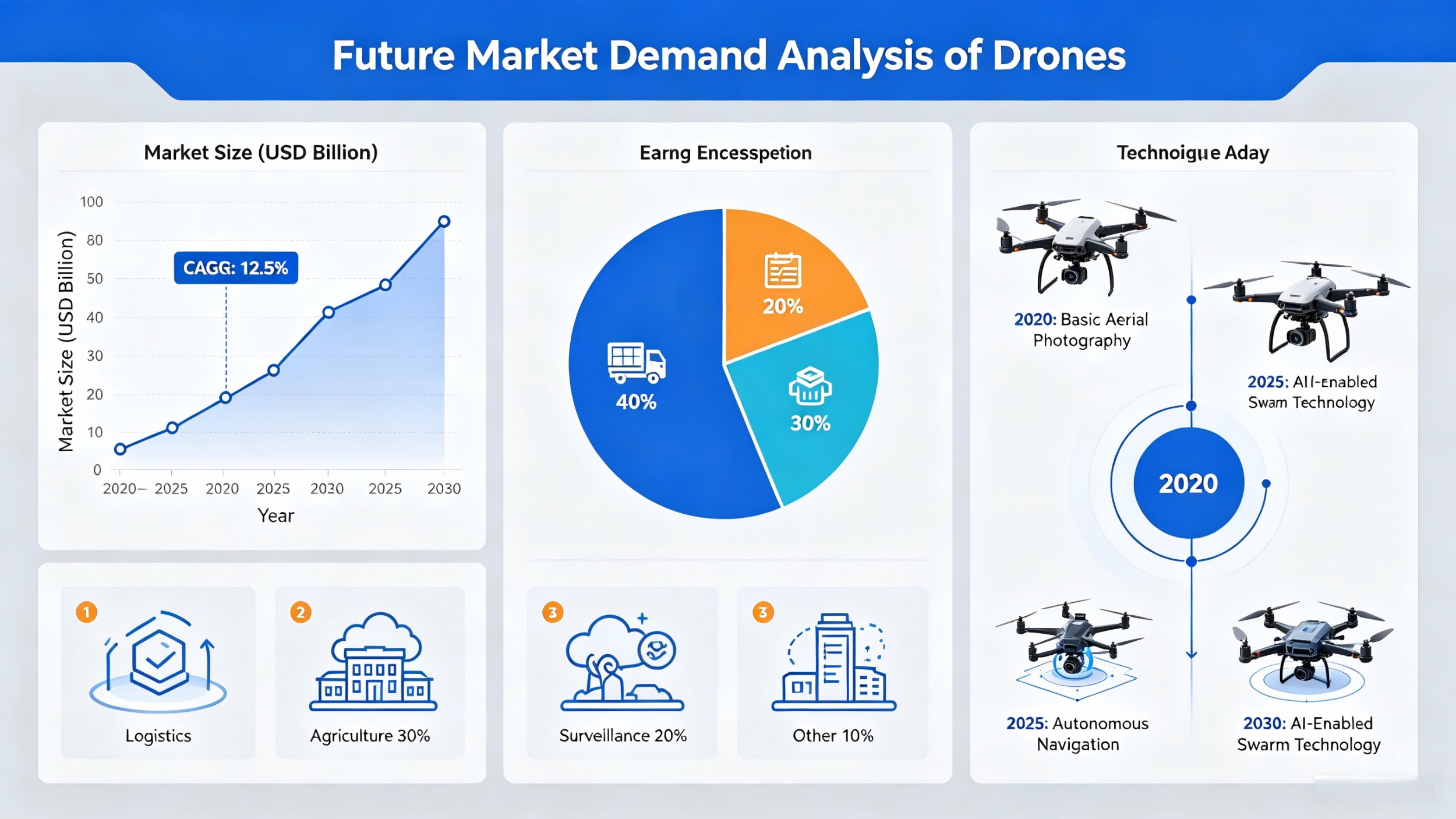
According to forecasts from multiple authoritative institutions, the global drone market size will reach USD 52.65 billion in 2026, and is expected to grow to USD 209.91 billion by 2035, with a CAGR of 16.77%, achieving a leap from the 100-billion-level to the trillion-level market. Among them, the civil market share is expected to surpass the military market for the first time in 2026, becoming the core source of industry growth.
2. Chinese Market: The World's Largest Producer and Consumer
As the core hub of the global drone industry, China contributes 70% of the global production capacity and 80% of the consumer-grade market share, with a market growth rate far exceeding the global average:
The size of China's civil drone market is expected to exceed RMB 200 billion in 2026, accounting for more than 50% of the global market share;
The market size is expected to reach RMB 320 billion by 2030, with an annual CAGR of approximately 18%;
The total scale of the supporting low-altitude economy is expected to exceed RMB 1 trillion in 2026, with a target core industry scale exceeding RMB 2.5 trillion by 2035, driving more than RMB 10 trillion in related industries.
II. Core Transformation of Demand Structure: Industrial-Grade Drones Become the Main Growth Engine, Consumer-Grade Drones Enter a Stock Iteration Period
In the future, the demand structure of the drone market will undergo a fundamental reversal: industrial-grade drones will completely replace consumer-grade drones as the absolute dominant force in the market, with significantly differentiated demand characteristics between the two categories.
1. Industrial-Grade Drones: Explosive Demand Growth from 'Pilot' to 'Large-Scale Implementation'
Rapidly rising market share: The market share of industrial-grade drones is expected to increase from 45% in 2024 to 58% in 2026, and will exceed 60% by 2030, becoming the core engine of industry growth;
Core demand logic: The core value lies in cost reduction and efficiency improvement, labor replacement, and solving pain points in high-risk scenario operations. In agriculture, energy, logistics, security and other fields, the operation efficiency of drones is several times or even dozens of times that of manual labor, while greatly reducing safety risks, resulting in extremely rigid demand;
Growth characteristics: From 2026 to 2030, the industrial-grade drone market is expected to achieve a CAGR of more than 25%, far exceeding the consumer-grade market, and will be the absolute main force of future demand growth.
2. Consumer-Grade Drones: Steady Demand Upgrade from 'Explosive Growth' to 'Stock Iteration + Scenario Extension'
Gradually declining market share: The market share of consumer-grade drones is expected to drop from 55% in 2024 to 42% in 2026, with the market entering a stock iteration era from the incremental era;
Core demand logic: The demand has fully upgraded from the early 'basic aerial photography function' to 'fool-proof operation + professional output + full-link experience'. Users no longer only focus on hardware parameters, but pay more attention to AI intelligent functions, content creation ecosystem, portability and safety;
Growth characteristics: From 2026 to 2030, the consumer-grade drone market is expected to maintain a CAGR of 8%-10%. The growth mainly comes from the stock replacement demand brought by intelligent upgrades, as well as the extended demand from new scenarios such as low-altitude cultural tourism, outdoor sports, and content creation.
III. Core Demand Drivers: Superposition of Policy, Technology and Scenario Dividends
The sustained release of future drone market demand is driven by three core engines: policy, technology and scenario, which form a closed loop and continuously expand the demand boundary.
1. Policy Dividends: Improved Institutional Guarantee to Solve Core Pain Points of Industry Development
Policy is the core support for the drone industry to develop from 'barbaric growth' to 'standardized and large-scale development', and also the prerequisite for demand release:
Clear top-level design: The low-altitude economy has been included in China's Government Work Report for many consecutive years, and was clearly listed as an 'emerging pillar industry' in 2026, incorporated into the core track of the national strategic layout;
Sound regulatory system: The newly revised Civil Aviation Law of the People's Republic of China was officially implemented in July 2026, which for the first time established special airworthiness certification provisions for unmanned aerial vehicles; the Guidelines for the Construction of Low-Altitude Economy Standard System clarifies that there will be more than 300 relevant standards by 2030, completely solving the institutional pain points of 'unstable flight and poor management' of drones;
Accelerated implementation of infrastructure: In February 2026, five Chinese ministries and commissions jointly issued a document, clarifying that the coverage rate of ground mobile communication networks for national low-altitude public air routes will be no less than 90% by 2027. The world's largest low-altitude dedicated communication network will be built, providing basic guarantee for beyond-visual-range flight and normalized operation of drones.
2. Technological Breakthroughs: Continuously Expanding Capability Boundaries and Creating New Demand Scenarios
Technological innovation is the core driving force for the continuous upgrading of drone demand, with comprehensive breakthroughs in core technologies expected in the next 5 years:
Full leap in intelligence: AI technology deeply empowers the entire 'perception-decision-execution' chain of drones. From 2026 to 2030, drones with autonomous obstacle avoidance, intelligent recognition, and cluster collaboration capabilities will become the mainstream. Around 2030, L4-level fully autonomous flight will be achieved, completely lowering the operation threshold and expanding application scenarios;
Innovation in energy and power: Breakthroughs in new energy technologies such as hydrogen fuel cells and solid-state batteries will push the endurance capacity of drones from the current 1-2 hours to 4-6 hours. Around 2028, hydrogen-powered industrial-grade drones will achieve commercial application, completely solving the core bottleneck of long-distance operations;
Upgrade in communication and navigation: The integration of 5G-A/6G networks and low-orbit satellite communication will build a globally covered low-altitude communication network, enabling beyond-visual-range flight of drones, real-time 4K video transmission, and normalized operations in remote areas, greatly expanding the coverage of demand.
3. Scenario Implementation: Full Industry Penetration from Single Aerial Photography, Continuously Creating Demand Increment
The application scenarios of drones have fully penetrated from early consumer-grade aerial photography to almost all industries including industry, agriculture, logistics, security, and public services. Scenario diversification is the core source of sustained demand growth:
Industrial scenarios: Scenarios such as agricultural plant protection, power inspection, logistics and distribution, oil and gas exploration, and construction surveying and mapping have achieved large-scale implementation, upgrading from 'labor replacement' to 'full-process intelligent operation', with continuously explosive demand;
Consumer scenarios: Extended from single aerial photography to diversified scenarios such as tourism follow-up shooting, extreme sports recording, short video content creation, low-altitude cultural tourism, and drone formation performance, continuously creating new demand;
Public service scenarios: Scenarios such as emergency rescue, urban governance, environmental monitoring, traffic management, and medical material distribution are driven by government policies, with rapidly growing demand, becoming a stable source of demand for the industry.
IV. Demand Differentiation in Segmented Scenarios: Significant Differences in Growth Potential Across Tracks
In the future, the demand growth of drones in different application scenarios will show significant differentiation. The growth potential of core tracks is as follows:
表格
Track Category Core Scenarios Expected Annual Growth Rate 2026-2030 Core Demand Characteristics and Growth Logic
Fastest Growing Track Low-Altitude Logistics and Distribution Over 40% The market size in China is expected to exceed RMB 50 billion in 2026, transforming from 'pilot operation' to 'normalized 30-minute urban delivery'. Demand for tonnage payload and long-endurance logistics drones is exploding, making it the fastest growing segmented track in the future.
Most Stable Growth Track Energy Inspection (Power/Oil & Gas/New Energy) 19% In 2024, State Grid of China completed more than 12 million kilometers of transmission line drone inspection, with the fault recognition accuracy rate increased to over 92%. In the future, it will transform from 'regular inspection' to 'real-time monitoring', with the application share in the new energy field increasing from 15% to 35% by 2030, and demand maintaining sustained and stable growth.
Largest Basic Demand Track Agricultural Plant Protection 15%-18% Accounting for 28% of the industrial-grade drone market in 2025, it is currently the largest industrial application scenario. Demand is upgrading from 'single pesticide spraying' to 'full-process agricultural monitoring, precision planting, and crop growth analysis', with continuously released demand in the sinking market.
Core Consumer-Grade Track Content Creation and Low-Altitude Cultural Tourism 10%-12% Generation Z has become the main consumer force. The sales share of models with AI editing, intelligent following, and 8K panoramic shooting functions increased from 15% in 2022 to 40% in 2024. Emerging demand such as low-altitude cultural tourism, drone formation performance, and outdoor sports follow-up shooting is growing rapidly.
Policy-Driven Track Public Services and Emergency Rescue 20%-25% Driven by government policies and financial investment, demand in scenarios such as urban governance, security monitoring, emergency rescue, and environmental monitoring continues to explode. Scenarios such as beyond-visual-range search and rescue and medical material distribution have achieved normalized application, with extremely rigid demand.
High-Growth Overseas Track Military and High-End Industrial-Grade 15%-20% The global military drone market size exceeded USD 32 billion in 2025, with the Middle East, Africa, and Latin America accounting for more than 45% of the demand. Demand for China's cost-effective high-end drones with actual combat experience is exploding. Saudi Arabia signed a USD 3 billion drone procurement order with China in 2025, with continuously released demand in the overseas market.
V. Core Upgrade Directions of Future Demand
In the future, the demand for the drone market will no longer be limited to the hardware itself, but will fully upgrade in four core directions: intelligence, compliance, ecosystem development, and diversification.
1. Intelligent Upgrade: Transformation from 'Manual Control' to 'Full Autonomy'
Future drones will completely get rid of the dependence on manual control, with AI technology enabling full-chain empowerment: from 2026 to 2027, the focus will be on developing AI-driven autonomous flight and intelligent shooting functions; from 2028 to 2029, L4-level autonomous flight capability will be achieved; after 2030, the development will move towards full intelligence and cluster collaboration. Models with autonomous decision-making, dynamic path planning, and complex environment adaptive capabilities will become the mainstream of the market.
2. Compliance Upgrade: 'One Drone, One Code, Full Traceability' Becomes the Standard for Market Access
With the improvement of the regulatory system, compliance will become the core access threshold for the drone market: by 2028, more than 90% of newly launched consumer-grade drones will have built-in compliant communication modules, with compatibility with the UTM (Unmanned Traffic Management) system and remote ID authentication capabilities. The airworthiness certification system for industrial-grade drones is gradually improved, with more than 50 mainstream industrial drone models expected to complete certification from 2026 to 2030. Compliant products will accelerate the occupation of market share, and demand will be concentrated on compliant leading enterprises.
3. Ecosystem Upgrade: Transformation from 'Single Hardware Sales' to 'Full-Link Closed-Loop Ecosystem'
Future market competition will shift from single hardware parameter competition to full-link ecosystem competition. Leading enterprises are building a closed-loop system of 'hardware + software + content platform + value-added services'. Subscription-based cloud storage, AI editing templates, aerial photography courses, data value-added services, and operation and maintenance services will become new demand growth points. What users purchase is no longer just a drone, but a complete set of solutions.
4. Diversification Upgrade: Transformation from 'Tool Equipment' to 'Core Node of the Low-Altitude Economy'
With the comprehensive development of the low-altitude economy, the application scenarios of drones will continue to diversify, extending from traditional aerial photography, inspection, and plant protection to the entire industrial chain including low-altitude logistics, air traffic, low-altitude cultural tourism, emergency medical care, and urban air mobility (UAM). Around 2030, eVTOL (electric Vertical Take-Off and Landing) vehicles will enter the household market. Drones will transform from a single tool equipment into the core support node of the low-altitude economy, continuously creating new demand increments.
VI. Potential Constraints and Risks to Demand Growth
Despite the extremely strong long-term growth certainty of the future drone market demand, there are still some potential constraints that may affect the release rhythm of demand:
Regulatory and Safety Risks: Regulations on airspace management, privacy protection, and flight safety are still in the process of improvement. Flight restrictions in core urban areas and sensitive areas of some cities will still restrict the release of demand. Flight safety accidents may also trigger regulatory tightening, affecting the development rhythm of the industry;
Technological Bottlenecks: There is still room for breakthroughs in long-endurance, large-payload, and autonomous flight technologies in complex environments. The localization of core components (such as high-end flight controllers, chips, and sensors) still needs to be advanced, which may restrict the implementation of demand in some high-end scenarios;
Market Competition and Homogenization: The consumer-grade market is plagued by serious product homogenization and fierce price wars, squeezing the profit space of small and medium-sized enterprises. The industrial-grade market has obvious advantages for leading enterprises and high technical barriers, limiting the demand expansion space for small and medium-sized enterprises;
Geopolitical Risks: Export controls and market access restrictions on Chinese drones by some countries may affect the release of demand for Chinese enterprises in overseas markets and increase the uncertainty of overseas expansion.
Final Summary
Overall, the long-term growth certainty of the drone market demand in the next 5-10 years is extremely strong. The large-scale implementation of industrial-grade scenarios will be the core driving force for industry growth, while the stock iteration and scenario extension of the consumer-grade market will provide stable demand support. The triple dividends of policy, technology and scenario will continue to promote the high-speed development of the industry.
Drones will completely get rid of the label of 'toy' and become an indispensable core tool in industrial production, public services, and daily life, as well as the core support carrier of the future trillion-level low-altitude economy. The global market size is expected to achieve more than 4 times growth from 2026 to 2035, and the Chinese market will continue to maintain its global leading position and become the core engine of industry growth. Want to know more link: http://www.youweic.com
Author:
YOUWEI TECHNOLOGIES(DONGGUAN) CO.LTD









Premium Cable Solutions
High-quality cables designed for superior performance and reliability across all your connectivity needs

Copyright © 2002-2026 YOUWEI TECHNOLOGIES(DONGGUAN) Ltd. All Rights Reserved.
Copyright © 2005-2015 YOUWEI TECHNOLOGIES(DONGGUAN) Ltd. All Rights Reserved.