

High-current anti-spark connector : Copper Alloy vs Silver Plating Contact Resistance Contrast Test Data
2026-06-11 11:07:31
Click:
“
For engineers and procurement specialists working on battery packs, BMS systems,
”
For engineers and procurement specialists working on battery packs, BMS systems, AGVs, electric forklifts, energy storage systems, charging piles and electric vessels, arcing, excessive temperature rise, terminal ablation and shortened service life of high-current connectors are long-standing critical pain points. In high-power DC scenarios ranging from 50A to 400A, live plugging and unplugging will easily generate strong electric arcs. The high temperature of the arc (up to thousands of degrees Celsius) will burn the contact terminals, accelerate material oxidation, increase contact resistance, and even trigger equipment failure and potential safety hazards such as short circuits and fire risks.Contact resistance is the core indicator that determines the conductive efficiency, heat generation and service life of high-current connectors. The material and surface coating of contact terminals directly affect the contact resistance performance under long-term high-current load and frequent plugging. As a professional manufacturer of high-current anti-spark connectors with 20 years of production experience, Youwei Technology has conducted a complete set of contact resistance comparison tests on pure copper alloy contacts and silver-plated contacts based on our core product QS Series Antispark connector. This article will share the real test data, analyze material performance differences, and explain how the QS Series eliminates arcing from the source, stabilizes low contact resistance, and solves the application pain points of industrial high-current connectors.
1. Fundamental Principle: Why Arcing and High Contact Resistance Occur
1.1 The Root Cause of Arcing During High-Current Plugging and Unplugging
Arcing is essentially air breakdown caused by instantaneous voltage spikes. When a high-current circuit is connected or disconnected, the inductive load will produce a sharp voltage surge following the formula ΔV = L·di/dt. Even a tiny air gap between terminals will be broken down to form an electric arc. Meanwhile, if the contact resistance of the terminal is too high, according to the Joule heat formula Q=I²Rt, a large amount of heat will accumulate instantly. High temperature will further oxidize the metal surface, form an insulating oxide layer, and push the contact resistance to rise continuously, forming a vicious cycle of 'high resistance → heat generation → oxidation → higher resistance → severe arcing'.In harsh working conditions such as frequent plugging, vibration and high humidity for AGVs and energy storage equipment, ordinary copper alloy terminals are more prone to surface wear and oxidation, which greatly amplifies arcing and temperature rise problems.
1.2 Anti-Spark Mechanism of QS Series Antispark Connector
Different from traditional ordinary connectors, the QS Series adopts a multi-dimensional anti-spark design to cut off arcing from the source:
- Built-in pre-charging resistance & soft start structure: Complete circuit pre-charging before full contact of terminals, suppress instantaneous current surges and voltage spikes, and avoid strong arcing during live plugging and unplugging.
- Optimized terminal structure: Maintain stable contact pressure under vibration and frequent plugging, ensure sufficient effective contact area, and restrain the rise of contact resistance.
- Dual material matching solution: Provide two terminal options of high-strength copper alloy and thick silver plating to adapt to different current grades, environmental conditions and cost demands, and keep contact resistance stable for a long time.
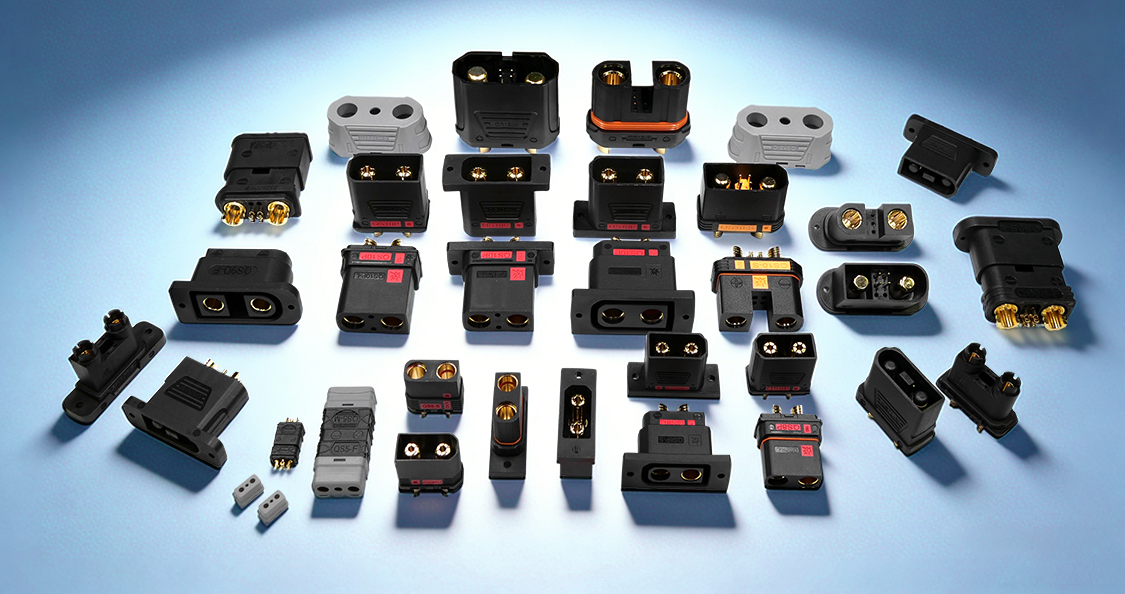
2. Contact Resistance Contrast Test: Copper Alloy VS Silver Plating Terminals
We set up a standardized test environment in the laboratory, simulating the actual working conditions of industrial high-current equipment. The test samples are QS Series connectors with the same structural size, and the only variable is the terminal contact material: pure copper alloy contact and copper-based silver-plated contact (silver plating thickness 2.5-5μm). The test items include initial contact resistance, contact resistance after 200 plugging cycles, steady-state temperature rise under rated current, and terminal surface status. All tests refer to IEC and UL industrial connector standards to ensure data authenticity and reference value.
2.1 Basic Test Conditions
- Test current: 100A / 300A DC (mainstream current specifications for energy storage and AGV)
- Ambient temperature: 25℃ (normal industrial working temperature)
- Plugging speed: Standard manual plugging and unplugging (simulate on-site operation)
- Plugging cycles: 200 times (simulate short-term frequent use)
2.2 Core Test Data & Result Analysis
2.2.1 Initial Contact Resistance (Unit: mΩ)
- Copper Alloy Contact: 2.8 ~ 3.5 mΩ
- Silver Plating Contact: 0.6 ~ 1.2 mΩ
Silver has the highest conductivity among common industrial metals. The silver-plated layer covers the copper alloy substrate, which greatly reduces the initial contact resistance. Under the same current, the conductive loss of silver-plated terminals is far lower than that of pure copper alloy terminals.
2.2.2 Contact Resistance after 200 Plugging Cycles (Unit: mΩ)
- Copper Alloy Contact: 5.6 ~ 7.2 mΩ (increased by more than 100%)
- Silver Plating Contact: 1.0 ~ 1.8 mΩ (increased by about 50%)
After frequent plugging, the surface of pure copper alloy is prone to slight wear and oxidation, and the oxide layer will significantly increase contact resistance. The silver-plated layer has excellent anti-oxidation and wear resistance. Even after repeated friction, it can still maintain a low resistance state, which is very suitable for AGVs, swap battery cabinets and other scenarios requiring frequent plugging.
2.2.3 Steady-State Temperature Rise (After 30 minutes of continuous 300A operation, Unit: ℃)
- Copper Alloy Contact: 48 ~ 55℃
- Silver Plating Contact: 22 ~ 28℃
High contact resistance brings serious heat accumulation. The temperature rise of copper alloy terminals under 300A high current is more than twice that of silver-plated terminals. Excessive temperature rise will accelerate the aging of connector plastic shells and internal components, and greatly shorten the overall service life of the equipment.
2.2.4 Terminal Surface Status after Test
- Copper Alloy Contact: Obvious oxidation discoloration at the contact point, slight ablation marks caused by tiny electric arcs.
- Silver Plating Contact: Smooth surface, no oxidation and ablation, intact silver-plated layer.
2.3 Comprehensive Performance Summary of Two Materials
- Copper Alloy Terminals: Cost-effective, good mechanical strength, suitable for low-frequency plugging, medium current (below 100A) and cost-sensitive projects such as ordinary battery packs and low-power industrial equipment. It is recommended to avoid frequent live plugging.
- Silver Plating Terminals: Ultra-low contact resistance, stable performance, strong anti-arcing and anti-oxidation capabilities, suitable for high current (100A-400A), frequent plugging, high vibration and high reliability scenarios, including large AGV fast charging ports, energy storage systems, electric vessels and high-power charging piles.
3. Practical Application Value of QS Series Antispark Connector
Combined with the above test data and anti-spark design, the QS Series perfectly solves the major pain points of high-current connectors for overseas industrial customers:
- Eliminate arcing fundamentally: The built-in pre-charging structure cooperates with high-performance terminals to realize safe live plugging and unplugging, avoid arc ablation, and improve on-site operation safety.
- Stable low resistance & low heat: Choose copper alloy or silver-plated terminals according to demands to control contact resistance and temperature rise within a safe range, reduce energy loss, and extend the service life of connectors and supporting equipment (the service life can reach more than 1000 plugging cycles).
- Adapt to complex environments: The whole series has passed CE, RoHS, ISO and other certifications, with corrosion resistance and vibration resistance, adapting to outdoor energy storage, vehicle-mounted AGV, marine and other harsh working environments.
- Flexible customization support: We support customizing terminal materials, silver plating thickness, pre-charging resistance parameters, appearance and wiring harness according to customer current, voltage, plugging frequency and installation space requirements, to match personalized project demands.
At present, the QS Series has been exported to more than 150 countries and regions around the world, and has been stably applied in many large-scale energy storage projects, AGV fleets and new energy battery supporting projects, winning consistent recognition from overseas engineers and procurement teams.
4. Conclusion & Inquiry Guidance
Contact resistance is the key to measuring the performance of high-current anti-spark connectors. Pure copper alloy and silver-plated contacts have their own advantages in cost, conductivity and durability. When selecting models, you can combine the project’s current grade, plugging frequency, working environment and budget to make a choice: select cost-effective copper alloy terminals for conventional medium-current and low-frequency use; select high-performance silver-plated terminals for high-current, frequent plugging and high-reliability industrial scenarios.As a one-stop manufacturer integrating R&D, production and customization, Youwei Technology’s QS Series Antispark connector relies on mature anti-spark technology and reliable material performance test data to provide stable and efficient high-current connection solutions for global industrial customers. We support sample customization, fast proofing within 3-7 days and mass production delivery within 10 days, with flexible MOQ and competitive cost.If you have any request please contact with my tech team http://www.youweic.com
Author:
YOUWEI TECHNOLOGIES(DONGGUAN) CO.LTD









Premium Cable Solutions
High-quality cables designed for superior performance and reliability across all your connectivity needs

Copyright © 2002-2026 YOUWEI TECHNOLOGIES(DONGGUAN) Ltd. All Rights Reserved.
Copyright © 2005-2015 YOUWEI TECHNOLOGIES(DONGGUAN) Ltd. All Rights Reserved.