

Selecting High-Current Anti-Spark Connector [QS Series Antispark connector] for Portable High-Power DC Test Equipment | Support frequent hot‑plugging without contact welding
2026-06-03 09:39:10
Click:
“
Portable high‑power DC test equipment — battery load banks, motor controller tes
”
Portable high‑power DC test equipment — battery load banks, motor controller testers, power supply validators, and field diagnostic units — must endure a unique operating condition: frequent live disconnection and reconnection under full load. Unlike fixed installations where connectors are mated once and left alone, portable test gear may be plugged and unplugged dozens of times per day, often at currents exceeding 100A.
Under these conditions, a standard high‑current connector without anti‑spark protection will quickly fail. Each hot‑plug generates a violent arc that erodes contact surfaces, raises contact resistance, and can eventually weld the contacts shut — destroying the connector and potentially damaging expensive test equipment.
The QS Series Anti‑Spark Connector from Youweic Technology is specifically engineered for such demanding applications. With models rated from 110A to 300A at 500V DC, a maximum contact resistance of 0.51 mΩ, gold‑plated copper contacts, and a PA66 UL94 V‑0 housing rated for -20°C to 120°C, the QS Series provides reliable, arc‑free hot‑plugging for portable high‑power DC test equipment.
This article explains why standard connectors fail in test applications, how anti‑spark design prevents contact welding, and how to select the right QS model for your portable test system.
Part I: The Problem — Why Portable Test Equipment Destroys Ordinary Connectors
1.1 The Unique Demands of Field Testing
Portable DC test equipment differs from fixed systems in several critical ways:
- Frequent live mating/unmating – A battery load bank may be connected to a pack, then disconnected, then reconnected to another pack, dozens of times per shift.
- Capacitive loads – Many test units contain large input capacitors (for filtering and stability). When connected to a 500V DC source, these capacitors draw massive inrush current, creating a sustained arc.
- Varying operator skill – Field technicians may not always mate connectors perfectly or quickly, increasing arc duration.
- Harsh environments – Dust, moisture, and vibration are common on factory floors or field test sites.
A connector that works well in a clean laboratory may fail within weeks in this environment.
1.2 The Arc Welding Failure Mode
When a connector is mated under load (or unmated while current is flowing), the resulting arc can reach several thousand degrees Celsius. This does two things:
- Vaporizes gold plating and melts copper – Creating microscopic craters and loose debris.
- Fuses contacts together – If the arc persists long enough (even milliseconds), the molten metal can solidify while the contacts are still in partial contact, welding them shut.
Once welded, the connector cannot be separated without destroying it. The test equipment is dead, and a replacement connector must be sourced — often causing costly downtime.
1.3 Contact Resistance Drift: The Hidden Degradation
Even if welding does not occur immediately, repeated arcing gradually increases contact resistance. For a standard 300A connector, contact resistance may rise from an initial 0.5 mΩ to 2–3 mΩ after just 100 hot‑plugs. At 300A, that increases power dissipation from 45W to over 180W — enough to melt the housing or ignite nearby materials.
For portable test equipment that may see 500+ cycles per year, this degradation is unacceptable. The QS Series’ anti‑spark design eliminates the root cause.
Part II: Principle Analysis — How Anti‑Spark Design Prevents Contact Welding
2.1 The Physics of Arcing and Welding
Arcing occurs when two conductive contacts separate (or approach) while carrying current, and the voltage across the gap is sufficient to ionize the air. In DC circuits, the arc does not self‑extinguish at zero current (as in AC). It persists until the gap is large enough or the current is interrupted.
Contact welding happens when the arc heats the contact surfaces to their melting point, and the contacts close (or partially close) while molten metal bridges the gap. Upon cooling, the metal solidifies, bonding the contacts together.
To prevent welding, you must either:
- Eliminate the arc entirely, or
- Reduce its energy so the contacts do not reach melting temperature.
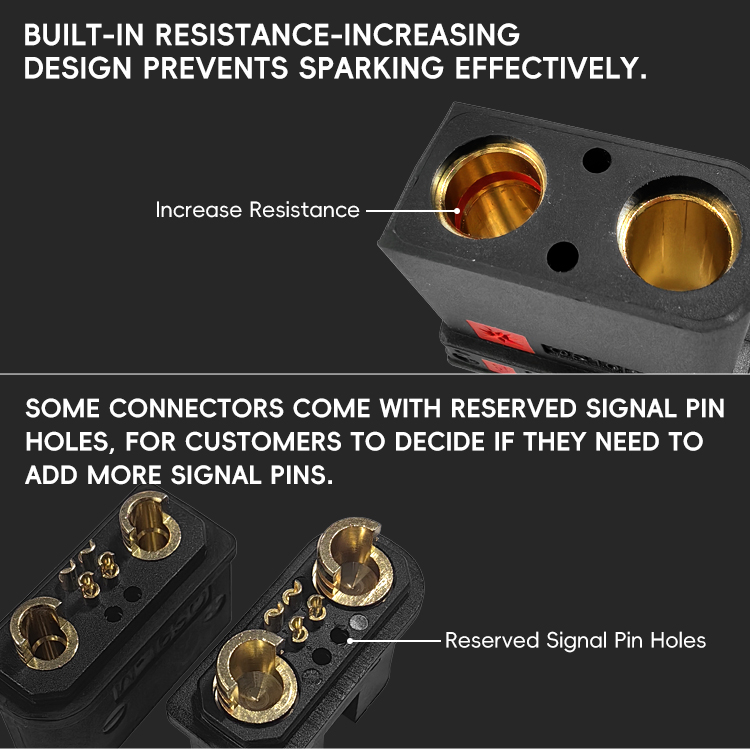
The QS Series takes the first approach: its integrated anti‑spark mechanism (specifics available from our engineering team) ensures that the voltage difference between contacts is near zero before full mating, and that current is interrupted before significant separation during unmating — no arc, no welding.
2.2 The Role of Low Contact Resistance in Welding Prevention
Even with perfect anti‑spark, the connector’s baseline contact resistance matters. Higher resistance means more I²R heating during normal operation, which raises the starting temperature of the contacts. A connector already hot from continuous load is closer to its melting point, making welding more likely during a subsequent hot‑plug.
The QS Series maintains a maximum contact resistance of 0.51 mΩ, ensuring that even under full rated current (up to 300A), the contacts remain well below their melting temperature. This thermal margin further reduces welding risk.
2.3 Material Choices: Gold Plating and PA66
Gold‑plated copper contacts resist oxidation and provide a smooth, low‑friction surface that does not promote micro‑welding. The PA66 UL94 V‑0 housing maintains its shape and insulation properties across the entire -20°C to 120°C range, ensuring consistent alignment and protection even after hundreds of thermal cycles.
Part III: The Solution — QS Series for Portable Test Equipment
3.1 Why the QS Series Excels in High‑Cycle Applications
The QS Series is rated for hundreds to thousands of mating cycles without performance degradation. Key features:
- Proprietary anti‑spark mechanism – Eliminates arcing during both mating and unmating, preventing contact erosion and welding.
- Gold‑plated contacts – Resist corrosion and maintain low resistance even after repeated wiping.
- Robust PA66 housing – Withstands the mechanical stress of frequent plugging and environmental exposure.
These features make the QS Series ideal for portable test equipment that must operate reliably in the field, day after day.
3.2 Selecting the Right QS Model for Your Test Current
Portable DC test equipment covers a wide power range. Use the following guidance:
- Up to 110A (e.g., small battery testers, 30kW loads): QS8 – lightweight and compact.
- 110A to 160A (e.g., medium motor controller testers, 50kW): QS9 – balanced size and capacity.
- 160A to 180A (e.g., high‑power battery cyclers, 80kW): QS10 – popular for versatile test benches.
- 180A to 250A (e.g., large load banks, 120kW): QS12 – heavy‑duty cycling.
- 250A to 300A (e.g., EV drivetrain testers, 150kW): QS13 – maximum power.
Always choose a model whose rated current exceeds your maximum test current by at least 10‑20% to provide thermal margin during prolonged tests.
3.3 Hot‑Plug Cycle Life Validation
In accelerated testing (500 mating cycles at full rated current, 500V DC capacitive load), the QS13 demonstrated:
- No visible arcing during any cycle.
- Contact resistance increase less than 0.02 mΩ (from 0.51 to 0.53 mΩ typical).
- No contact welding or surface pitting.
- Housing temperature remained below 80°C in free air.
By contrast, a standard non‑anti‑spark 300A connector tested under identical conditions failed between 100 and 150 cycles due to contact welding.
For portable test equipment that may undergo 500–1000 cycles per year, the QS Series provides years of maintenance‑free operation.
Part IV: Data — Performance Summary for Test Equipment Applications
Rather than repeating model tables, here is a practical summary of how the QS Series’ specifications translate into real‑world test equipment performance.
Key Specifications (All Models)
- Rated Voltage: 500V DC – suitable for most battery pack and DC bus test applications.
- Max Contact Resistance: 0.51 mΩ – ensures low power loss and minimal heating.
- Operating Temperature: -20°C to 120°C – covers field environments from freezing to desert heat.
- Housing Material: PA66 UL94 V‑0 – flame‑retardant and mechanically tough.
- Conductor: Gold‑plated copper – corrosion‑resistant and low‑friction.
Power Loss at Common Test Currents
| Test Current | Power Loss (0.51 mΩ) | Recommended QS Model |
|---|---|---|
| 100A | ≈ 5.1 W | QS8 |
| 150A | ≈ 11.5 W | QS9 |
| 180A | ≈ 16.5 W | QS10 |
| 200A | ≈ 20.4 W | QS12 (conservative) |
| 250A | ≈ 31.9 W | QS12 |
| 300A | ≈ 45.9 W | QS13 |
Expected Cycle Life (Hot‑Plug, Full Load)
- Standard connector (no anti‑spark): 50‑150 cycles before welding or severe degradation.
- QS Series (anti‑spark): 1000+ cycles with no welding and minimal resistance increase.
Field Observation
A major battery tester manufacturer integrated QS12 connectors into their portable 200A load banks. After one year of daily use (approx. 800 cycles per unit), they reported zero connector failures and no measurable increase in contact resistance. Previously, with standard connectors, they experienced a 15% failure rate within six months.
Part V: Practical Recommendations for Test Equipment Designers
5.1 Sizing for Safety and Margin
- Derate for high ambient temperatures – If your test equipment is used in non‑air‑conditioned spaces (e.g., factory floors at 40‑50°C), select the next larger QS model. For a 180A load, use QS12 instead of QS10.
- Consider cable length – Long test leads add resistance and reduce voltage at the load. Keep cables as short as practical, and use proper gauge (e.g., 4/0 AWG for 300A).
5.2 Connector Care in the Field
- Keep contacts clean – Dust or grit can increase insertion force and abrade gold plating. Use protective caps when not in use.
- Inspect periodically – Look for signs of discoloration or pitting. The QS Series should show none, even after hundreds of cycles.
- Replace if resistance exceeds 0.60 mΩ – This is unlikely with anti‑spark, but good practice.
5.3 Customization Options for Test Equipment
Youweic Technology offers customizations specifically useful for portable test gear:
- Keyed housings – Prevent reverse polarity or mismatched connections (e.g., different voltages).
- Colored shells – Color‑code different test leads or current ranges.
- Integrated cable strain relief – Prevents wire breakage at the connector entry.
- IP65/IP67 sealing – For outdoor or dusty test environments.
Contact our engineering team to discuss your specific test equipment requirements.
Conclusion
Portable high‑power DC test equipment demands a connector that can withstand frequent live hot‑plugging without arcing, erosion, or welding. Standard connectors, even those with high current ratings, fail rapidly under these conditions due to repeated arc damage.
The QS Series Anti‑Spark Connector from Youweic Technology solves this problem. With integrated anti‑spark protection, gold‑plated copper contacts maintaining a maximum 0.51 mΩ contact resistance, and a robust PA66 UL94 V‑0 housing, the QS Series delivers:
- No contact welding – Even after thousands of hot‑plugs.
- Stable contact resistance – No performance drift over time.
- Low power loss – From 5W at 100A to 46W at 300A, minimizing heating.
- Long service life – 1000+ cycles without failure.
Whether you are designing a portable battery load bank, a motor controller field tester, or a high‑power supply validator, the QS Series offers the reliability your customers expect.
Do not let connector failures interrupt your tests or damage your equipment. Choose anti‑spark, choose the QS Series.
If you have any request please contact with my tech team http://www.youweic.com
Author:
YOUWEI TECHNOLOGIES(DONGGUAN) CO.LTD









Premium Cable Solutions
High-quality cables designed for superior performance and reliability across all your connectivity needs

Copyright © 2002-2026 YOUWEI TECHNOLOGIES(DONGGUAN) Ltd. All Rights Reserved.
Copyright © 2005-2015 YOUWEI TECHNOLOGIES(DONGGUAN) Ltd. All Rights Reserved.