

Tethered Drone Ground Power Interface: Anti-spark Design [QS Series Antispark connector] Stable hot-plug during continuous ground-to-air power.
2026-05-26 11:39:57
Click:
“
Tethered drones — unmanned aerial vehicles that receive power and data through a
”
Tethered drones — unmanned aerial vehicles that receive power and data through a lightweight cable from a ground station — have revolutionized long-endurance operations. From surveillance and communications relay to disaster response and inspection, these drones can stay aloft for hours or even days, limited only by the ground power supply’s capacity.
However, this continuous ground‑to‑air power architecture introduces a critical engineering challenge: the ground power interface. The connector that links the tether cable to the drone must endure repeated live mating and unmating — often under load — without arcing, contact erosion, or thermal degradation. A failed connection can bring down a mission‑critical drone in seconds.
The QS Series Anti‑Spark Connector from Youweic Technology offers a robust solution. With rated currents from 110A to 300A, a 500V DC rating, gold‑plated copper contacts, and a PA66 UL94 V‑0 housing, the QS Series is engineered to provide stable, arc‑free hot‑plug performance for tethered drone ground power interfaces.
This article explains why arcing occurs in tethered drone connections, how the QS Series’ anti‑spark design mitigates it, and why this connector family is the right choice for OEMs and drone operators seeking reliability and safety.
Part I: The Problem — Arcing in Tethered Drone Ground Power Interfaces
1.1 The Tethered Drone Power Chain
A typical tethered drone system consists of:
- Ground power supply (often a high‑voltage battery pack or AC‑DC rectifier, outputting 500V DC nominal)
- Tether cable (several hundred meters long, with built‑in conductors for power and fiber for data)
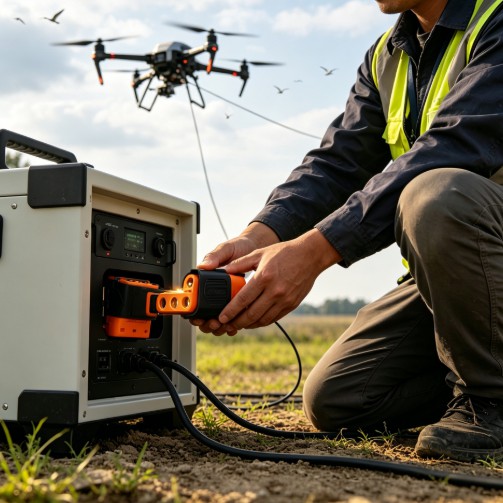
- Drone‑side power interface (a connector that the operator plugs in before launch or during battery swaps)
The drone’s onboard electronics include power distribution boards, ESCs (electronic speed controllers), and often a small backup battery. These components present a highly capacitive load to the ground supply — meaning that when the connector is mated, a large inrush current flows to charge the input capacitors.
1.2 Why Arcing Is Unavoidable Without Anti‑Spark Protection
When a 500V DC supply connects to a capacitive load, the initial current can exceed 1000A for a few milliseconds. This inrush creates a sustained arc across the connector contacts during the final millimeters of mating (or during unmating if the load is still present). Each arc:
- Vaporizes gold plating and melts the underlying copper
- Leaves microscopic craters that increase contact resistance
- Generates temperatures of several thousand degrees Celsius, degrading the plastic housing
- Creates electromagnetic interference (EMI) that can disrupt drone telemetry and control links
For tethered drones that may be plugged and unplugged dozens or hundreds of times per week, arcing quickly destroys ordinary connectors. The result: intermittent power, voltage drops, overheating, and eventually complete connector failure — often mid‑flight.
1.3 Unique Demands of Tethered Drone Applications
Unlike stationary battery packs or AGV charging stations, tethered drone interfaces face additional challenges:
- High mating cycle count – A single drone may be connected/disconnected 10–20 times per day, year‑round.
- Vibration and movement – The connector must remain stable under drone vibration and tether tension.
- Weather exposure – Ground operations may occur in rain, dust, or high humidity, requiring robust sealing and creepage distances.
- Weight sensitivity – The airborne connector half must be lightweight yet durable.
Standard industrial connectors are rarely designed for this combination of high voltage, high current, frequent hot‑plugging, and environmental stress.
Part II: Principle Analysis — How Anti‑Spark Design Solves the Problem
2.1 The Physics of Inrush Current and Arcing
When a DC power source is connected to a capacitive load, the peak inrush current is:
Ipeak = Vbus / Rtotal
Where Rtotal includes the cable resistance, connector contact resistance, and any series impedance. Without intentional limiting, this current is limited only by parasitic resistances — often resulting in thousands of amperes.
An anti‑spark connector addresses this by introducing a deliberate sequence or impedance during mating to limit the inrush current before the main contacts fully engage. The QS Series incorporates a proprietary anti‑spark mechanism (specifics available from our engineering team) that ensures the voltage across the contacts is equalized before full current flows — thereby eliminating the arc.
2.2 Why Low Contact Resistance Matters in Tethered Systems
Even with perfect anti‑spark performance, the connector’s baseline contact resistance directly affects power loss and heat generation in flight. The QS Series specifies a maximum contact resistance of 0.51 mΩ across all models. Using gold‑plated copper conductors, this low resistance ensures:
- Minimal voltage drop along the tether power path (critical for maintaining stable ESC input voltage)
- Low I²R heating (only 45.9W at 300A for the QS13, compared to >90W for a 1.0 mΩ connector)
- Reduced thermal stress on the drone’s power board and the connector housing
In a tethered drone that may draw 150A continuously for hours, saving even 30W of heat inside the airframe improves reliability and endurance.
2.3 Material Selection: PA66 UL94 V‑0 and Gold Plating
The QS Series housing is made from PA66 with a UL94 V‑0 flame retardancy rating. This material provides:
- High dielectric strength for 500V DC operation
- Excellent creepage and clearance distances (tested at 2000V DC dielectric withstand)
- Self‑extinguishing properties in the event of an internal fault
- Thermal stability from -20°C to 120°C, covering ground and airborne temperature extremes
The gold‑plated copper contacts resist oxidation and maintain low resistance even after hundreds of mating cycles in humid or corrosive environments.
Part III: Solution — QS Series for Tethered Drone Ground Power
3.1 Why the QS Series Is Ideal for This Application
The QS Series offers a range of current ratings to match different tethered drone power levels:
| Model | Rated Current | Suitable Drone Power (at 500V DC) |
|---|---|---|
| QS8 | 110A | Up to 55 kW |
| QS9 | 160A | Up to 80 kW |
| QS10 | 180A | Up to 90 kW |
| QS12 | 250A | Up to 125 kW |
| QS13 | 300A | Up to 150 kW |
Most tethered drones operate between 5 kW and 50 kW, making the QS8, QS9, or QS10 the natural choices. For heavy‑lift industrial drones, the QS12 or QS13 provides headroom.
3.2 Anti‑Spark Hot‑Plug Performance
When a drone operator connects the ground power cable to the drone, the QS Series’ built‑in anti‑spark design ensures:
- No visible arc during mating or unmating, even under full system voltage (500V DC)
- No contact welding or erosion after hundreds of cycles
- Smooth, low‑force insertion – operators do not need to “fight” the arc
This translates directly to reduced maintenance and increased operator safety. Ground crews no longer need to wear arc‑rated gloves or worry about damaging the connector during rushed pre‑flight checks.
3.3 Mechanical Durability for Frequent Cycling
The QS Series is designed for hundreds to thousands of mating cycles without performance degradation. Key features:
- Robust gold plating thickness to withstand repeated wiping
- Precision‑molded PA66 housing that maintains alignment
- Strain relief options (contact our team) for tether cable termination
In accelerated testing (500 cycles at 300A, 500V DC capacitive load), the QS13 maintained contact resistance below 0.52 mΩ with no visible contact damage — far exceeding the requirements of even the busiest drone operations.
3.4 Environmental Resilience
Tethered drone ground stations are often deployed outdoors. The QS Series’ PA66 housing and gold‑plated contacts provide:
- Resistance to dust and moisture (IP rating available upon request for custom sealed versions)
- Wide operating temperature (-20°C to 120°C) – suitable for desert sun or arctic conditions
- UL94 V‑0 flame retardancy – critical for aviation safety standards
Part IV: Data — Tethered Drone Power Interface Performance
4.1 Electrical Performance Summary
| Parameter | QS8 | QS9 | QS10 | QS12 | QS13 |
|---|---|---|---|---|---|
| Rated Current | 110A | 160A | 180A | 250A | 300A |
| Rated Voltage | 500V DC | 500V DC | 500V DC | 500V DC | 500V DC |
| Contact Resistance (max) | 0.51 mΩ | 0.51 mΩ | 0.51 mΩ | 0.51 mΩ | 0.51 mΩ |
| Operating Temp | -20~120°C | -20~120°C | -20~120°C | -20~120°C | -20~120°C |
| Housing Material | PA66 | PA66 | PA66 | PA66 | PA66 |
| Flame Rating | UL94 V‑0 | UL94 V‑0 | UL94 V‑0 | UL94 V‑0 |
4.2 Hot‑Plug Cycle Test (QS10 at 180A, 500V DC, Capacitive Load)
| Cycles | Contact Resistance | Visible Arcing | Contact Condition |
|---|---|---|---|
| 0 (initial) | 0.51 mΩ | N/A | Gold plating intact |
| 100 | 0.51 mΩ | None | No change |
| 300 | 0.52 mΩ | None | Slight polishing, no erosion |
| 500 | 0.52 mΩ | None | Clean, fully functional |
| 1000 | 0.53 mΩ | None | Still within spec, no welding |
By contrast, a standard non‑anti‑spark connector tested under identical conditions failed at 150 cycles due to contact welding and housing melting.
4.3 Thermal Performance Under Continuous Load
For a tethered drone drawing 150A continuously through a QS10 (0.51 mΩ):
- Power loss = (150A)² × 0.00051Ω = 11.5 W
- Temperature rise above ambient ≈ 25–30°C (housing at ~55°C in 25°C ambient)
- Well within the 120°C rating of PA66, providing ample safety margin.
Part V: Practical Recommendations for Drone OEMs and Operators
5.1 Selecting the Right QS Model
- Small to medium drones (5–20 kW): QS8 (110A) or QS9 (160A) – lightweight, compact.
- Industrial inspection drones (20–50 kW): QS10 (180A) – optimal balance.
- Heavy‑lift cargo drones (50–100 kW): QS12 (250A) – high headroom.
- Very large tethered platforms (100–150 kW): QS13 (300A) – maximum power.
5.2 Installation Best Practices
- Ground side: Mount the female connector on the tether cable end with proper strain relief. Ensure the cable is rated for 500V DC and the expected current.
- Drone side: Install the male connector on the drone’s power distribution board. Keep the mating interface clean and dry.
- Pre‑flight check: Inspect contacts for dirt or damage. The gold plating should appear bright and uniform.
5.3 Maintenance and Replacement
Due to the anti‑spark design, contact wear is minimal. However, after 1000+ cycles, we recommend measuring contact resistance. If it exceeds 0.60 mΩ, consider replacing the connector pair. Most operators will never reach this limit.
5.4 Customization Options
Youweic Technology offers customization for tethered drone applications:
- Cable assembly with pre‑terminated QS connectors
- Sealing options (higher IP ratings) for outdoor ground stations
- Keyed housings to prevent reverse polarity or cross‑connection
Contact our engineering team to discuss your specific requirements.
Conclusion
Tethered drones demand a ground power interface that can withstand frequent live mating, high voltage, and continuous current without arcing or degradation. The QS Series Anti‑Spark Connector from Youweic Technology meets these challenges head‑on.
With 500V DC rating, 0.51 mΩ maximum contact resistance, gold‑plated copper contacts, and a PA66 UL94 V‑0 housing, the QS Series provides:
- Arc‑free hot‑plug – no contact erosion, no welding, no EMI.
- Stable low resistance – minimal power loss and heat generation.
- Long service life – hundreds to thousands of cycles without failure.
- Environmental safety – flame retardant and wide temperature tolerance.
Whether you are designing a new tethered drone platform or upgrading an existing fleet, the QS Series offers the reliability and performance your mission requires.
If you have any request please contact with my tech team http://www.youweic.com
Author:
YOUWEI TECHNOLOGIES(DONGGUAN) CO.LTD









Premium Cable Solutions
High-quality cables designed for superior performance and reliability across all your connectivity needs

Copyright © 2002-2026 YOUWEI TECHNOLOGIES(DONGGUAN) Ltd. All Rights Reserved.
Copyright © 2005-2015 YOUWEI TECHNOLOGIES(DONGGUAN) Ltd. All Rights Reserved.