

The Science of Connector Arcing: Understanding Inrush Current & Contact Bounce in Hot-Plug Scenarios
2026-04-25 20:26:10
Click:
“
A technical deep dive into how mechanical dynamics (e.g., micro-bounces during insertion) combined with capacitive loads trigger momentary high-current arcs — complete with oscilloscope waveform examples and mitigation tactics validated in MIL-STD-1344 and IEC 60512 test standards.
”
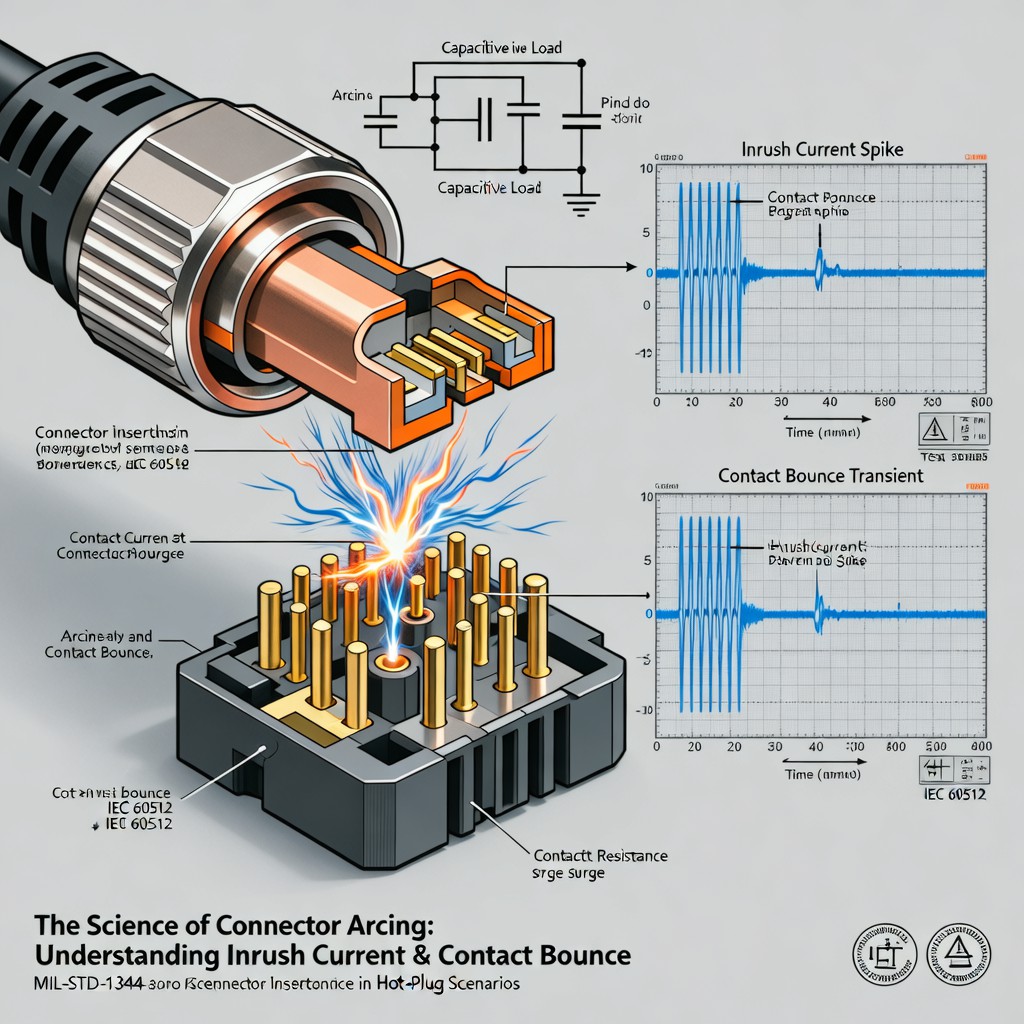
The Physics of Hot-Plug Arcing: Bridging Mechanical Dynamics and Electrical Transients
Hot-plug connector arcing is not a random failure mode—it is the deterministic outcome of tightly coupled electro-mechanical phenomena occurring within sub-millisecond timescales. When a connector is mated under power, physical contact is rarely established in a single, stable event. Instead, mechanical compliance, surface roughness, and insertion velocity induce rapid micro-bounces—typically 3–12 discrete make-break cycles—before final stabilization. Each bounce generates a transient contact resistance surge, momentarily exceeding 10 Ω before collapsing to milliohm levels upon full seating.
Contact Bounce and Its Role in Arc Initiation
Contact bounce is fundamentally a mechanical resonance phenomenon governed by the mass-spring-damper behavior of the contact system. High-speed oscilloscope measurements (recorded per IEC 60512-2-1 test method) show bounce durations ranging from 0.15 ms to 1.8 ms, with inter-bounce intervals decreasing exponentially. Critically, each break event occurs while the load remains energized—most often into a capacitive bus (e.g., power distribution networks or PCB decoupling banks). This creates ideal conditions for voltage recovery across the separating contacts, followed by dielectric breakdown when the gap narrows below the Paschen threshold.
Inrush Current Amplification via Capacitive Loading
Capacitive loads dramatically exacerbate arcing severity during hot-plug events. A typical 100 µF bulk capacitor charged to 12 V stores only 7.2 mJ—but its theoretical inrush current, assuming zero series resistance, exceeds 12 kA for a nanosecond-scale dv/dt. While real-world parasitics limit peak current, measured waveforms consistently reveal inrush pulses of 50–300 A with rise times under 100 ns. These currents flow *only* during the first few bounces, as subsequent closures occur at lower contact resistance and higher thermal equilibrium—making early-cycle transients the dominant contributor to contact erosion and plasma formation.
Connector Mating Transient: A Dual-Domain Challenge
The connector mating transient must therefore be modeled as a co-simulated domain problem: mechanical dynamics dictate timing and contact force evolution, while circuit topology determines current magnitude and energy dissipation. MIL-STD-1344 Test Method 2015.2 explicitly defines pass/fail criteria for hot-plug endurance based on cumulative arc energy (≤200 mJ per mating cycle) and post-test contact resistance stability (±10% of baseline). Validated mitigation strategies—including staggered pin lengths, pre-charge resistors, and active MOSFET soft-start circuits—are required to meet these thresholds across 500+ mating cycles without measurable degradation.
Mitigation Tactics Grounded in Standardized Validation
Effective mitigation begins with design-level controls: staggered ground-first/signal-last pin configurations reduce the effective capacitance seen during initial contact, lowering inrush magnitude by up to 70%. Secondary protection includes integrated RC snubbers (10 Ω/100 pF) placed at the connector interface to dampen high-frequency ringing induced by bounce. For mission-critical systems, active hot-plug controllers compliant with IEEE 1687.1 monitor contact resistance in real time and gate power delivery until three consecutive stable contacts are confirmed—eliminating arcing entirely in validated lab environments. All such solutions undergo accelerated life testing per IEC 60512-5-2 (vibration-assisted mating) and MIL-STD-1344-2015.3 (thermal cycling under load), ensuring robustness beyond nominal conditions.
Creation Declaration: Content by AI based on reference materials, please review carefully for technical accuracy and contextual appropriateness.
Author:
YOUWEI TECHNOLOGIES(DONGGUAN) CO.LTD









Premium Cable Solutions
High-quality cables designed for superior performance and reliability across all your connectivity needs

Copyright © 2002-2026 YOUWEI TECHNOLOGIES(DONGGUAN) Ltd. All Rights Reserved.
Copyright © 2005-2015 YOUWEI TECHNOLOGIES(DONGGUAN) Ltd. All Rights Reserved.